|
|
|
|
|
 |
|
|
|
|
|
|
|
|
Cranston Fine Arts  Aviation Art World War Two Veteran Signatures UK and Commonwealth W Aviation Art World War Two Veteran Signatures UK and Commonwealth W  Winwood, Bert Winwood, Bert |

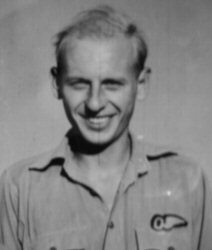
Warrant Officer Bert Winwood
WO A.E. 'Bert' Winwood was a Navigator on Mosquitoes and Beaufighters, flew only with pilot Ray Harrington attached to 603 sqn in the Greek Campaign. Bert did his Navigator training in Canada and in January 1944 was posted to 603 Squadron on Beaufighters, based at Gambut, near Tobruk. From here they launched attacks right across the Mediterranean into Crete, Greece and the Aegean Islands against shipping, harbour installations and enemy aircraft with much success. In December 1944 he was posted to 235 Squadron at RAF Banff flying as navigator on Mosquito's flying in the Banff Strike Wing. In April 1945 he was shot down when returning from a strike in the Kattegat, he and his pilot Ray Harrington avoided capture, and with the help of the Danish resistance made it home to England. After a short rest he continued to fly again from RAF Banff, he left the RAF in 1946. Bert Winwood passed away in 2012.


| Warrant Officer Bert Winwood - Signed Aviation Art |
|
|
|
|
|
|
|
|
|
|
|
|
|
| Text for the above items : |
Seastrike by Ivan Berryman. Without doubt one of the most outstanding and versatile aircraft in the Allied inventory during World War II, the Bristol Beaufighter was to endure a cautious reception by its crews when it first entered service, not least due to difficulties experienced by crews attempting to abandon a stricken aircraft in an emergency. Its performance and hard-hitting potential quickly overcame such doubts, however, and it went on to earn a commendable reputation - and the nickname Whispering Death. Here, two 254 Sqn TF. MkXs attack a captured Norwegian vessel in 1945. |
Trainbusters by Nicolas Trudgian. So versatile was the Mosquito that is performed in every role allotted to the R.A.F. and R.C.A.F. during World War II. Made almost entirely of wood, and powered by two hefty Merlin engines, it was the fastest piston engined aircraft of the war. Seen in its intruder configuration, Mosquitos of 418 Squadron, R.C.A.F. led by Charlie Krause, make a devastating high speed low-level attack on railroad marshalling yards in northern France during the winter of 1944 |
Half-Salvo by Ivan Berryman. A Bristol Beaufighter of No.248 Sqn, Banff Strike Wing, fires off a half-salvo of four rockets. |
The Mosquito's Sting by Ivan Berryman. Banff Mosquito H of 404 Squadron flown on its first operational mission by Flying Officer A Catrano and Flight Lieutenant A E Foord spots a German Blohm and Voss Bv138 anchored off Kjevik. They attacked the Bv138 which blew up before going on to attack a Heinkel He115 floatplane which was in the vicinity. This drawing shows the Mosquito beginning its attack on the Bv138. |
Knockout Blow by Ivan Berryman. Banff Mosquito H of 404 Squadron flown on its first operational mission by Flying Officer A Catrano and Flight Lieutenant A E Foord spots a German Blohm and Voss Bv138 anchored off Kjevik. They attacked the Bv138 which blew up before going on to attack a Heinkel He115 floatplane which was in the vicinity. This drawing shows the Mosquito making its attack on the Heinkel as the Bv138 explodes in the distance. |
Vital Support by Robert Taylor. Crucial to every squadron in the RAF were the unsung heroes of World War II - the ground crew. Without the vital support of these dedicated men who refuelled the aircraft, rearmed them, maintained them and kept them flying, the pilots and aircrew would, quite simply, never have got into the air. Robert Taylors drawing Vital Support shows ground crew bombing up a Mosquito of RAF Bomber Command. |
Trouble Brewing by Keith Aspinall. Beaufighter and Torbeau of Coastal Command. |
Top Dog by Robert Taylor. Completing a record 213 operational sorties with Bomber Commands Pathfinder Force, Mosquito LR503 became one of the most successful aircraft in the Royal Air Force during World War II. It flew first with 109 Pathfinder Squadron, and then 105 Pathfinder Squadron, completing more combat missions than any other Allied aircraft. |
Clipped Signature - Bert Winwood. Flew as Navigator on Beaufighters with No.603 Sqn in North Africa throughout 1944, then joined No.235 Sqn on the Mosquito based at Banff. With his pilot, he evaded capture with help from Danish resistance after being shot down in April 1945. He died in 2012. |
Night Raiders by Ivan Berryman. A pair of de Havilland Mosquito NF. MkII night fighters of 23 Squadron, based at Bradwell Bay, Essex in 1942. |
Prowler's Return by Ivan Berryman. Rocket rails empty, Mosquito FB.VI RS619 (LA-F) of 235 Sqn races home low and fast after another successful anti-shipping strike in the Fjords of Norway. On a subsequent mission on 5th April 1945, this aircraft crash-landed in Denmark after suffering a glycol leak. Its crew, Ray Harrington and Bert Winwood, managed to get back home to the UK with the help of the Danish Resistance. |
Mosquitos by Keith Woodcock. On a cold winter' day with some snow covering the taxi ways on a RAF airfield, Royal Air Force ground crew engineers work on the engine of a Mosquito. A fitting tribute to the Mosquito fighter bomber and all the crews that flew in and also worked on this magnificent aircraft. |
Return From Leipzig by Anthony Saunders. Mosquitos of 105 Squadron, Marham. No. 105 Squadron, stationed at Marham, Norfolk, became the first Royal Air Force unit to become operational flying the Mosquito B. Mk. IV bomber on 11th April 1942. The painting shows 105 Squadron on the raid of 10th April 1945, to the Wahren railway marshalling yards at Leipzig, Germany. |

Bert Winwood signing Return From Leipzig
|
Contact Details |
|
Sign Up To Our Newsletter!
This website is owned by Cranston Fine Arts. Torwood House, Torwoodhill Road, Rhu, Helensburgh, Scotland, G848LE Contact: Tel: (+44) (0) 1436 820269. Email: cranstonorders -at- outlook.com
|
|
|





